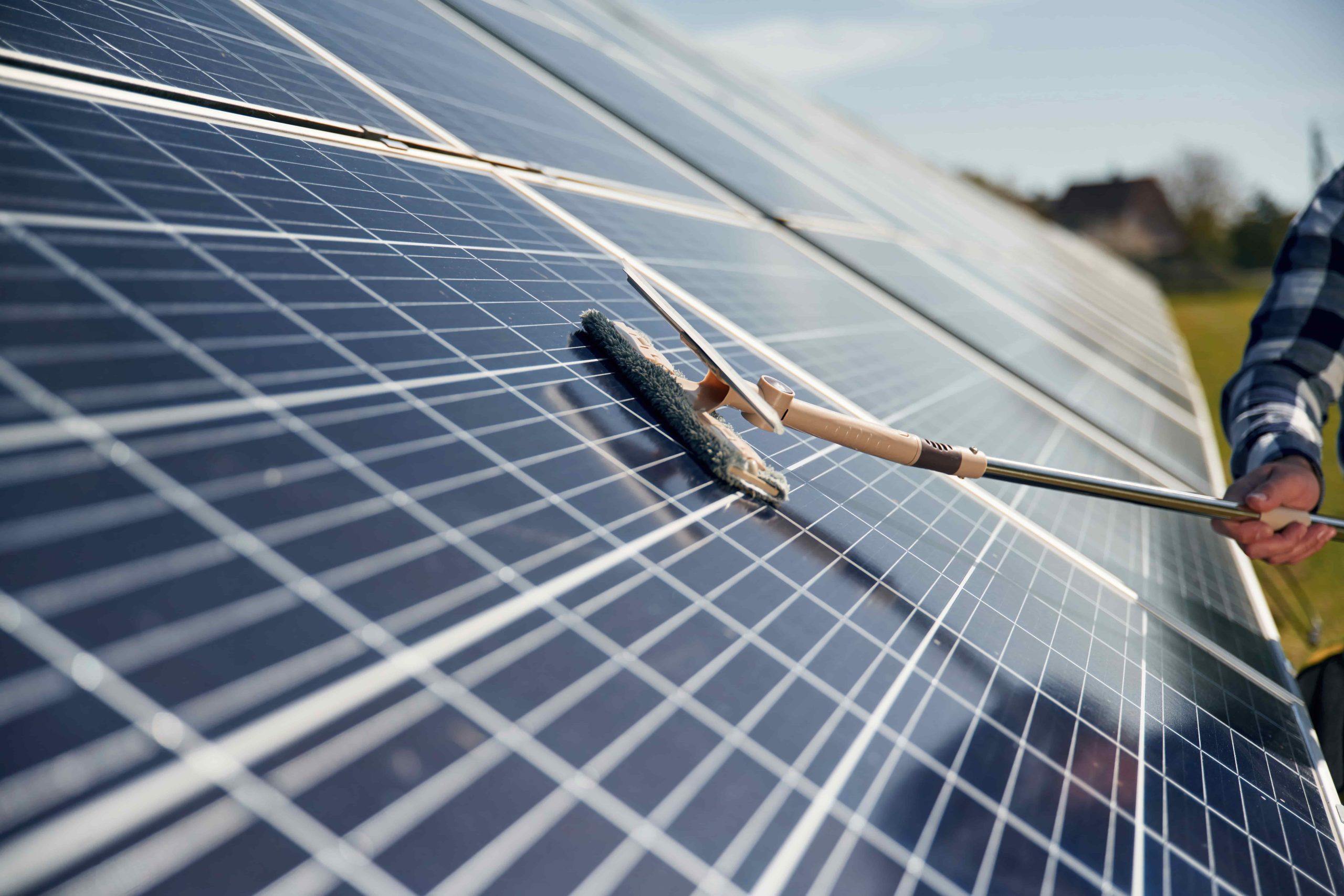
Cleaning solar panel arrays on roofs safely includes making sure panels are cool, using deionised water, and a soft brush on an extension pole. No pressure washer should be used anywhere near the glass. Most of the damage we see on Gold Coast rooftops was not caused by dirt. It was caused by someone cleaning the panels the way they would clean a driveway.
This covers when your panels actually need cleaning, the three things that damage them, the safe step-by-step method, the two risks that make this a professional job on a lot of homes, and what a professional clean involves.
Do Your Solar Panels Actually Need Cleaning?
Rain does a reasonable job on a panel tilted at 20 degrees or more, and a light layer of dust is worth very little in lost output. What rain does not fix is the stuff that sticks. Bird droppings are the worst offender, because a solid patch blocks a cell completely rather than dimming it, and a fully shaded cell can drag down the whole string it sits in. Salt film on a coastal roof, pollen through spring, tree sap, and the grey haze that builds under a low tilt all sit in the same category, as does algae creeping in from the frame edges on a shaded roof.
Check your monitoring app or inverter before you decide. Compare this month against the same month last year, allowing for weather. A gradual decline of a few per cent that recovers after rain is soiling. A sudden drop, or one string underperforming the others, is a fault that cleaning will not fix.
On the Gold Coast, twice a year suits most homes: once after the spring pollen and once at the end of summer, when salt, storm debris and bird droppings have had their run. Panels within a few streets of the water, under gum trees, or on a low-pitch roof are worth doing more often.
What Not to Do: Pressure, Chemicals and Abrasives
This is the part worth reading twice, because these three mistakes cause damage you cannot undo.
Never use a pressure washer on solar panels
A pressure washer is the most common way homeowners wreck an array. High pressure can crack or chip the glass, stress the cells into micro-cracks you will not see but will pay for in output, and drive water past the edge seals into the frame and junction box. Water inside a panel means corrosion, then failure. Almost every manufacturer’s warranty excludes damage caused by high-pressure cleaning, so the repair bill lands on you.
The same goes for a jet nozzle on a garden hose. If it stings your hand, it is too much for the seals.
Never use an abrasive brush or scourer
Panel glass carries an anti-reflective coating, a microscopically thin layer whose entire job is letting light through instead of bouncing it off. A scouring pad, a stiff-bristle brush or a bit of grit dragged across the surface will scratch that coating. Those micro-scratches are permanent. They scatter light, and they cost you efficiency every day for the rest of the system’s life. Dirt washes off. A scratch does not.
That is also why you clear loose debris dry first. Half the scratching that happens on a roof is a soft brush pushing a piece of grit around.
Go easy on the chemicals
Solvents, ammonia-based glass cleaners and anything acidic can degrade the anti-reflective coating and the seals around the frame. A little mild detergent is fine on stubborn grime, provided it is rinsed off completely, because detergent residue dries into a film that attracts more dirt and leaves you worse off than before. Rinse until the water runs clear.
How to Clean Solar Panels on a Roof, Step by Step
Assuming the panels need it and the roof is safe to work around, here is the method:
- Read the manufacturer’s instructions. Every brand publishes cleaning guidance, and following it is usually a condition of the warranty. Some specify water only, or a maximum water temperature.
- Shut the system down. Follow the shutdown procedure on the label on your inverter; normally, the inverter first, then the AC isolator, then the DC isolator. Panels produce DC whenever there is light on them, so this is not optional.
- Pick your time. Early morning is ideal. The panels are cool, and the roof is not baking. Cold water on hot glass risks thermal shock, and midday water evaporates before you can squeegee it, which is how you get mineral spotting.
- Clear the loose dirt dry. Brush or blow off leaves, twigs and grit before any water goes on. This is the step that prevents most scratching.
- Rinse gently. A garden hose at normal household pressure, no jet nozzle. Work from the top of the array down and let the water do the loosening.
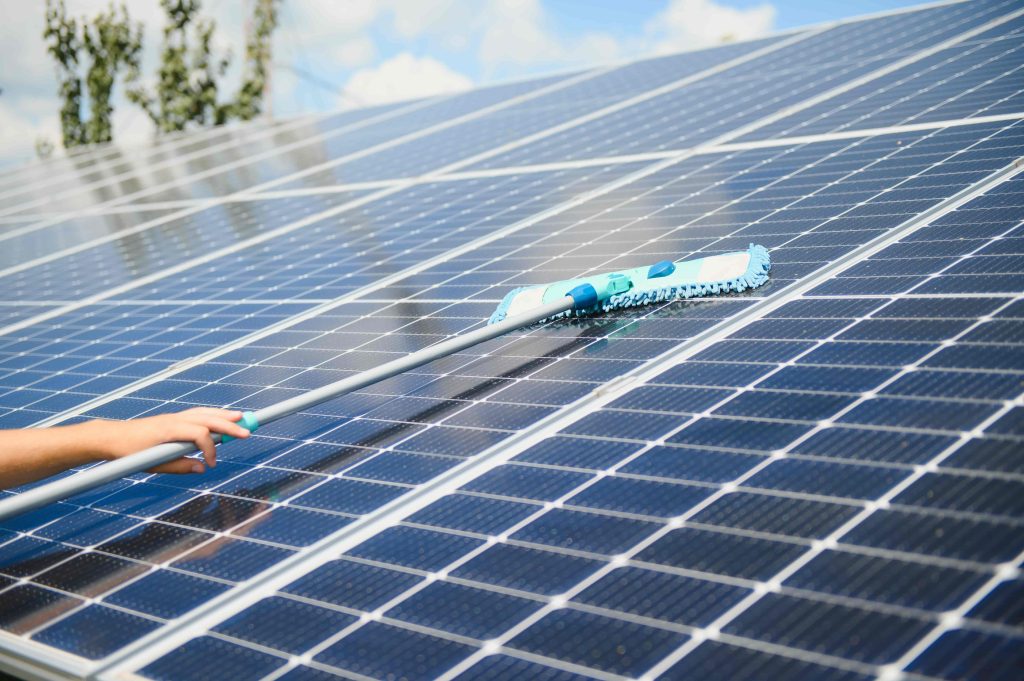
- Wash with a soft brush. A soft brush or microfibre head on an extension pole, using deionised water where you can get it. Light pressure, straight strokes, and keep the soft brush wet so nothing is dragged dry across the glass.
- Final rinse and dry. Rinse everything off, then squeegee or dry with clean microfibre. Deionised water has the minerals stripped out, so it dries without spotting. Hard water does not, which is the main reason a professional clean looks different to a DIY one.
- Restart the system in reverse order and check that the inverter and monitoring app are reporting normally.
Work from the ground with an extension pole wherever the array can be reached that way. It is the same low-pressure, soft washing logic we use on painted render and roof sheeting. Gentle contact, let the water do the work. And never walk on solar panels. The glass is not built to carry your weight, and the micro-cracks a footstep leaves do not show up until your output starts sliding.
The Two Real Risks To Be Aware Of: Heights and Electricity
Everything above assumes you can reach the panels safely. On a lot of Gold Coast homes, you cannot, and this is where the honest answer stops being a how-to.
Falls are one of the most common causes of serious injury around the home, and a wet tile roof at a 25-degree pitch with a hose across it is about as bad as domestic footing gets. A ladder on soft ground, a two-storey drop, a fragile roof sheet, or no anchor point are all reasons to stop.
Working at heights takes safety gear that most households do not own, and a few per cent of efficiency is not worth a fall.
The electrical risk is less obvious. Solar panels are not an appliance you can unplug: they generate DC whenever daylight hits them, and DC arcs do not self-extinguish the way household AC does. Shutting down the isolator stops power from flowing into your home, but the panels and the cabling between them stay live.
Never hose a panel with visible damage, a cracked cell, a scorched connector or chewed cabling, and keep water clear of the junction box.
Stop and call an electrician if:
You can see cracked or delaminated glass, brown scorch marks on a cell, a burnt smell at the inverter, damaged cabling, or one string dead in your monitoring app. That is a fault, not dirt, and safety says it needs an accredited installer rather than a cleaner.
When to Call a Professional
Hand it over when the roof is steep, two-storey or multi-level, when there is no safe ladder position, when the array is big enough that you would be up there for hours, or when the build-up will not shift with a rinse.
Also, hand it over if shutting the system down and restarting it yourself makes you uneasy, because doing it in the wrong order is a real safety issue.
A professional clean at Jet Set Pro starts with switching the system off and inspecting every panel for damage before anything gets wet. From there, it is soft brushes, a low-pressure rinse through carefully chosen nozzles, and a squeegee and microfibre finish so the glass dries without water marks. We work off extension poles from the ground where the array allows it, and we are fully insured for work at heights.
One thing Jet Set Pro is not: an electrician. If we spot cracked glass, scorching or damaged cabling while we are up there, we tell you and stop. Faults and repairs belong with an accredited installer. Accreditation moved from the Clean Energy Council to Solar Accreditation Australia in 2024, so if you are searching for a CEC-accredited installer, SAA-accredited is the current equivalent and worth checking before you book anyone.
Want it done without the ladder? Request a free, no-obligation quote for solar panel cleaning through the form on this page, or call Jet Set Pro on 0482 702 903. We clean solar panels across the Gold Coast, South Brisbane and the Tweed.
Frequently Asked Questions
Can you pressure wash solar panels?
No. High pressure can crack the glass, create micro-cracks in the cells and force water past the edge seals into the frame and junction box, and most manufacturers exclude that damage from the warranty. Use a garden hose at household pressure with a soft brush instead.
How often should solar panels be cleaned on the Gold Coast?
Twice a year suits most Gold Coast homes, once after spring pollen and once at the end of summer. Panels near the water, under gum trees, or on a low-pitch roof that rain does not rinse well need it more often. Your monitoring app is the best guide: a gradual few per cent decline that recovers after rain means soiling.
What is the best water to use on solar panels?
Deionised or purified water, because the minerals have been stripped out, and it dries without spots or a chalky film. Ordinary hard water leaves mineral residue as it evaporates, which is why DIY cleans often look streaky. If deionised water is not available, rinse thoroughly and dry the glass with a squeegee before it dries on its own.
Does cleaning solar panels actually improve output?
Yes, but keep expectations realistic. Soiling costs a typical system around 3 to 5 per cent of annual production, so a light dust layer is worth very little. Heavy build-up is different, particularly bird droppings, because one fully blocked cell can drag down every panel in its string.
Does cleaning solar panels void the warranty?
Cleaning them correctly does not. Cleaning them with a pressure washer, abrasive pads or harsh chemicals usually does, because most manufacturers specify a method and exclude damage caused by anything outside it. Check the manufacturer’s instructions first, and stick to water, a soft brush and mild detergent at most.
Can I clean solar panels from the ground?
Often, yes, and it is the safer option. A soft brush on a telescopic extension pole reaches most single-storey arrays from ground level, with no need to get on the roof at all. Two-storey homes, steep pitches and large arrays are where the pole runs out, and a professional with height safety gear makes sense.
If your panels need more than a rinse, or the roof is not somewhere you want to be, Jet Set Pro cleans rooftop solar across the Gold Coast, South Brisbane and the Tweed. Request a free, no-obligation quote online, or call 0482 702 903.
About the Author
Stuart, Owner, Jet Set Pro Exterior Cleaning Solutions
Stuart owns and runs Jet Set Pro Exterior Cleaning Solutions, a family-run exterior cleaning business on the Gold Coast. He and his team clean solar panels, roofs, gutters and house exteriors across the Gold Coast, South Brisbane and the Tweed, and spend a good part of every summer on ladders looking at what salt film, pollen, and bird droppings do to rooftop solar.