Concrete looks solid and indestructible, but it’s a porous material and not a single block of stone. That smooth finish you see on top is a thin, protective “skin” (or surface paste) that keeps the rest of the slab safe.
When this layer stays intact, concrete resists moisture, dirt, and wear. Older concrete is especially vulnerable because that protective paste has already thinned over time from weather, traffic, and UV exposure.
If that protective layer gets “scratched” or blasted away, your concrete starts drinking up water like a straw. This makes it much easier for it to crumble or develop those annoying cracks that only get worse over time.
Water absorption is a real problem in terms of maintaining the structural integrity of concrete. It has been reported that concrete can absorb up to 5% of its weight for every foot of thickness. This makes it vulnerable to cracking, freeze-thaw related issues and losses in structural integrity. Not to mention, the presence of water creates the ideal growing conditions for mould, moss and algae accumulation on your concrete surfaces.
3 Ways DIY Pressure Washing Destroys Your Concrete
#1 Surface Etching (The “Permanent Graffiti” Effect)
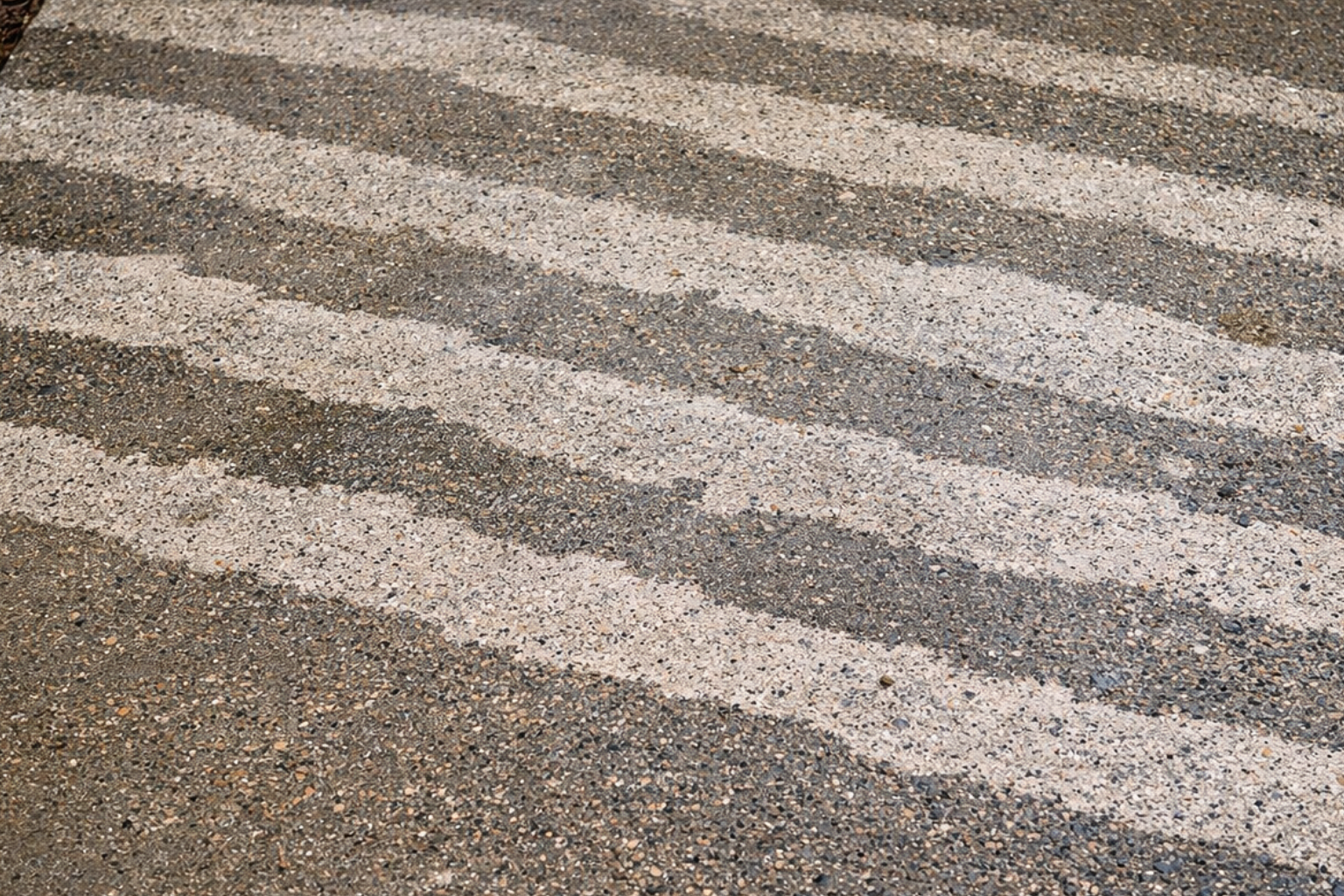
Surface etching is a form of mechanical degradation where the water’s impact force exceeds the concrete’s compressive strength. The most common sign of etching is what pros call Tiger Striping or the Zebra Effect.
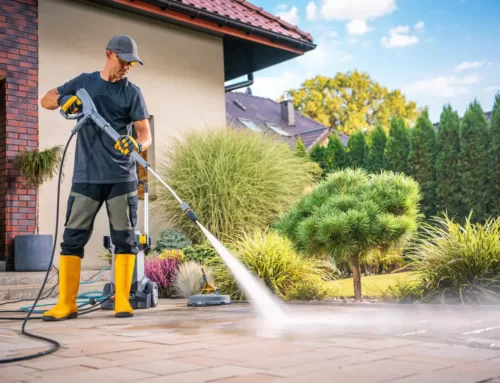
A standard consumer pressure washer can produce anywhere from 3,000 to 4,000 PSI (Pounds per Square Inch). When you use a narrow nozzle (like a 0° or 15° tip), you concentrate that entire force into a laser-thin point.
At this intensity, the water acts as an abrasive medium, much like a sandblaster, physically scouring away the cement paste. If concrete driveway or patio cleaning is not done correctly, instead of just removing surface contaminants like dirt and algae, the water begins to micro-fracture the concrete surface itself.
#2 Exposing the Aggregate (Pitting)
Concrete relies on cement paste to bind sand and crushed stone together. When pressure washing is done incorrectly, the water stream erodes that paste instead of cleaning it, forcing the aggregate below to rise to the surface.
Exposed aggregate causes uneven light reflection that makes concrete appear old and unclean at all times. The expanded surface area then encourages faster biological growth.
#3 Forced Moisture Intrusion
Concrete behaves like a sponge.
Its surface contains thousands of tiny pores and capillaries that absorb water. When a pressure washer is set too high, it forces water deep into those pores.
Trapped water inside your slab creates a massive freeze-thaw risk. As temperatures drop, this moisture freezes and expands, hammering the concrete from the inside out.
A single winter cycle can transform your hidden water damage into a web of ugly, visible cracks, especially if your concrete is already aged or stressed.
Why “Stronger” Isn’t Better When Cleaning Concrete
Hiring a professional isn’t just about paying for labour, it’s about paying for a completely different level of technology and chemistry. While a DIY project relies on brute force, a professional approach uses the right tools and science to protect your property.
Most homeowners focus on PSI (Pounds per Square Inch), but house washing experts prioritize GPM (Gallons per Minute) and cleaning detergents, to assist in breaking down the contaminants prior to the application of water pressure. Cleaning detergents assist in breaking down the organic growth and other contaminants, whilst High GPM allows a pro to “flush” the surface with water volume rather than “stabbing” it with high pressure.
Professionals use the following:
- High-Flow Pumps
- Buffer Tanks
- Dual-Lance Wands
- Softwash Systems
- Cleaning Agents
Spinning nozzles inside a professional surface cleaner wash the slab evenly from edge to edge. The tool stays at a fixed height, so the pressure stays consistent and avoids tiger striping. The result is a clean, smooth surface with no streaks or patchy lines.
The DIY Test: Are You Equipped to Clean Concrete Safely?
- Can your machine produce at least 4–5 Gallons Per Minute?
- Do you have the correct surfactants and algaecides to kill mould roots?
- Do you have a walk-behind surface cleaner to prevent permanent etching?
- Do you have professional-grade insurance to cover accidental property damage?
- Can you guarantee you won’t blast away the “cream layer” of the slab?
- Do you know which spray tip gives the widest fan so the pressure doesn’t hit the concrete in one harsh spot?
- Do you have a way to control where dirty wash water goes so detergents don’t flow into storm drains or break local rules?
IMPORTANT DISCLAIMER: The Cost of a Single “No”
Concrete restoration is far more expensive than professional maintenance. If you cannot check every single box on this list, you are not just cleaning your driveway, you are gambling with it.
Even one missing requirement significantly increases your risk of permanent property damage. Missing the correct GPM or Surface Cleaner leads to irreversible etching and “zebra stripes” that no amount of scrubbing can fix.
Conclusion
When you treat your concrete with care, it stays tough, dense, and perfectly sealed against the elements. Think of it as an anti-aging treatment for your property that keeps cracks and ugly stains at bay for years to come.
Why spend your weekend wrestling with a rental when you can let Gold Coast’s Jet Set Pro Exterior Cleaning handle the heavy lifting? We’re experts at making patios and driveways look absolutely pristine without any of the risks of DIY damage. You’ll get a gorgeous, uniform clean that protects your concrete for the long haul.
Across the Gold Coast from Southport to Pacific Pines, Labrador to Nerang, contact us to get started and let’s get your home or business shining again.